AI automation · Start here
AI Process Audit.
Know what to automate next.
A paid, fixed-scope assessment of one area of work. You leave with a written recommendation your team can act on, with us or with anyone else.
- Covers
- One process in one team, from the work arriving to the record or decision it produces.
- You provide
- A sponsor, a process owner, the people who handle exceptions, approved samples and a systems contact.
- You receive
- A process map, a ranked shortlist, a benefit and cost model, and a recommended first scope.
- Not included
- Building a prototype, cleaning data or connecting live systems. Those are scoped separately.
- Fee and schedule
- A fixed fee and dates, confirmed in writing before any work begins.
An example of how an audit is scoped. Your process, interviews and evidence set the actual scope and quote.
Who it is for
Several ideas.
One decision to make.
For an operations, finance or service leader with a team spending too much time on administration, a list of automation ideas, or a proposal that is hard to judge.
We examine active handling time, handoffs, exceptions and the systems behind the process, then compare improvements by likely benefit, feasibility and running cost.
The recommendation may be an AI-assisted workflow, a direct integration, a change to a tool you already own, or groundwork to complete before investing.
What you receive
A report built for the next decision.
Written findings, then a working session to challenge the recommendation and agree what happens next.
| Deliverable | What it contains | What it helps you decide |
|---|---|---|
| Current process map | Steps, owners, systems, handoffs, handling time and recurring exceptions. | Where the effort sits and which parts should change. |
| Opportunity shortlist | Options ranked by value, feasibility, data readiness and risk, with the reasoning. | What to pursue first, what to defer and what to leave alone. |
| Benefit and cost model | A sourced baseline, scenarios, assumptions and the cost of building and running the approach. | Which assumptions must hold for the investment to make sense. |
| Recommended first scope | A bounded workflow, integration needs, human controls, success measures and open dependencies. | What a delivery team should validate or build next. |
A worked example
From invoice to a decision.
A fictional accounts-payable team handles 600 invoices a month. The sample shows how a promising idea becomes a testable recommendation.
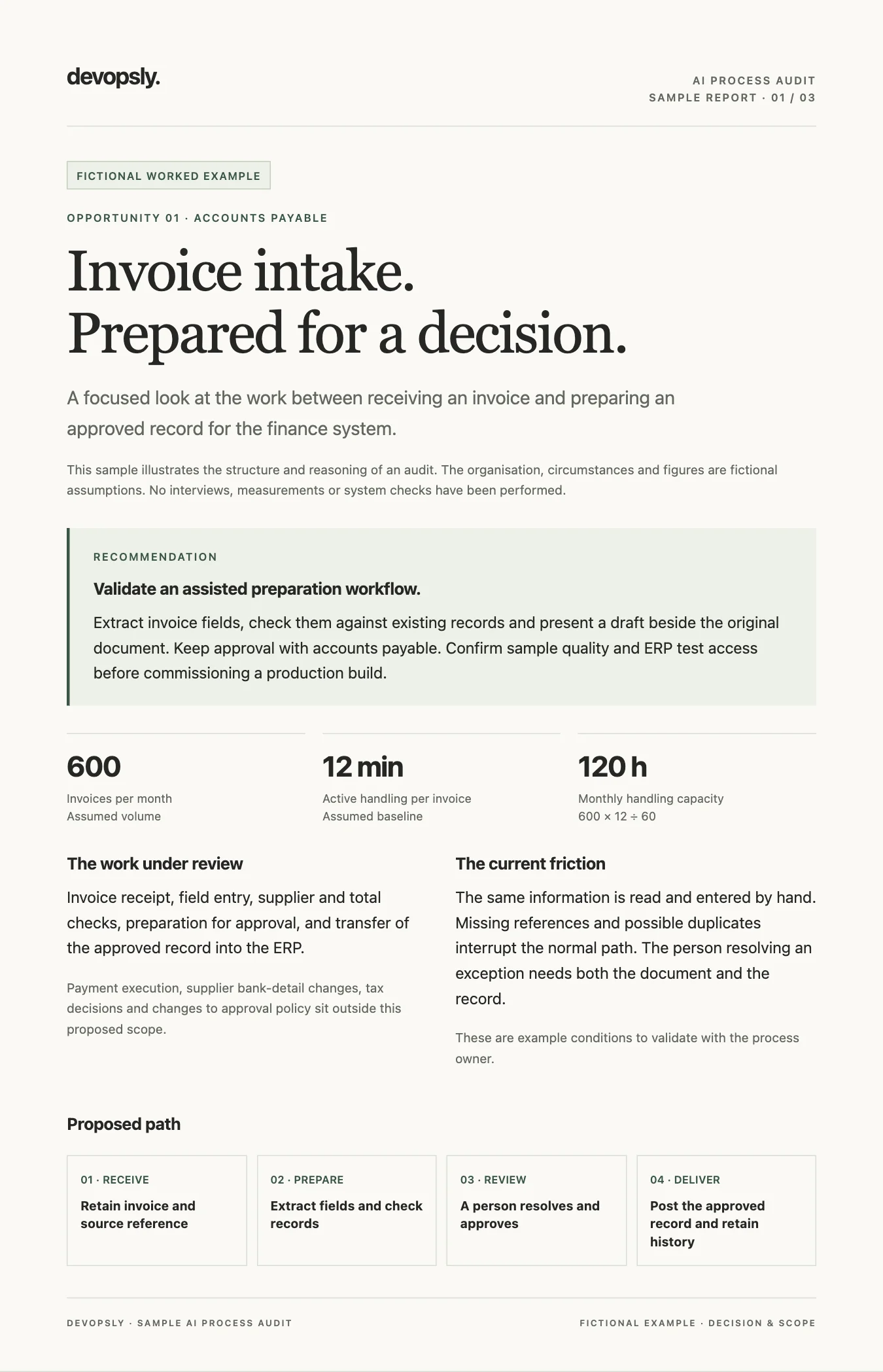 Open the full sample
Sample report · three pages
Fictional exampleWhat the three pages show.
- Decision and scope. The recommendation, the assumed volumes and the proposed path, with what is outside the scope.
- Benefit and evidence. Cautious, working and upper scenarios, the costs to establish and the evidence to collect first.
- Pilot and acceptance. A bounded pilot, the acceptance checklist and the people needed for the next step.
Working assumption in the sample: 600 invoices × (12 − 6 minutes) ÷ 60 = 60 hours of capacity a month. Capacity, not a measured result or a cash saving.
The web version is the accessible one. The PDF is the same three pages for printing or sharing.
How the audit works
Observe the work.
Test the assumptions.
Four steps with the people who know the process.
Set the boundary
Agree the workflow, the decision to support, who is involved and how evidence will be handled.
Map what happens today
Walkthroughs, interviews and approved samples show the normal path and the work hidden in exceptions.
Compare practical options
Weigh likely benefit, data quality, system access, cost and the controls each approach needs.
Hand over the decision
Review the findings together: the recommendation, its uncertainties and the next step you can commission.
Audit questions
Before you commission.
How much does it cost, and how long does it take?
Are we committing to an implementation?
Will we receive a savings figure?
Do you need live access to our systems?
What if our data or access is incomplete?
Start with one process
Where is the effort going?
Tell us which team does the work, how it happens today and what you need to decide. We’ll reply with a proposed scope and quote.