Financial records
A ledger from the ground up.
Devopsly designed the financial ledger to retain transaction history, making the financial record an explicit part of the architecture.
Fintech product / Flyfish
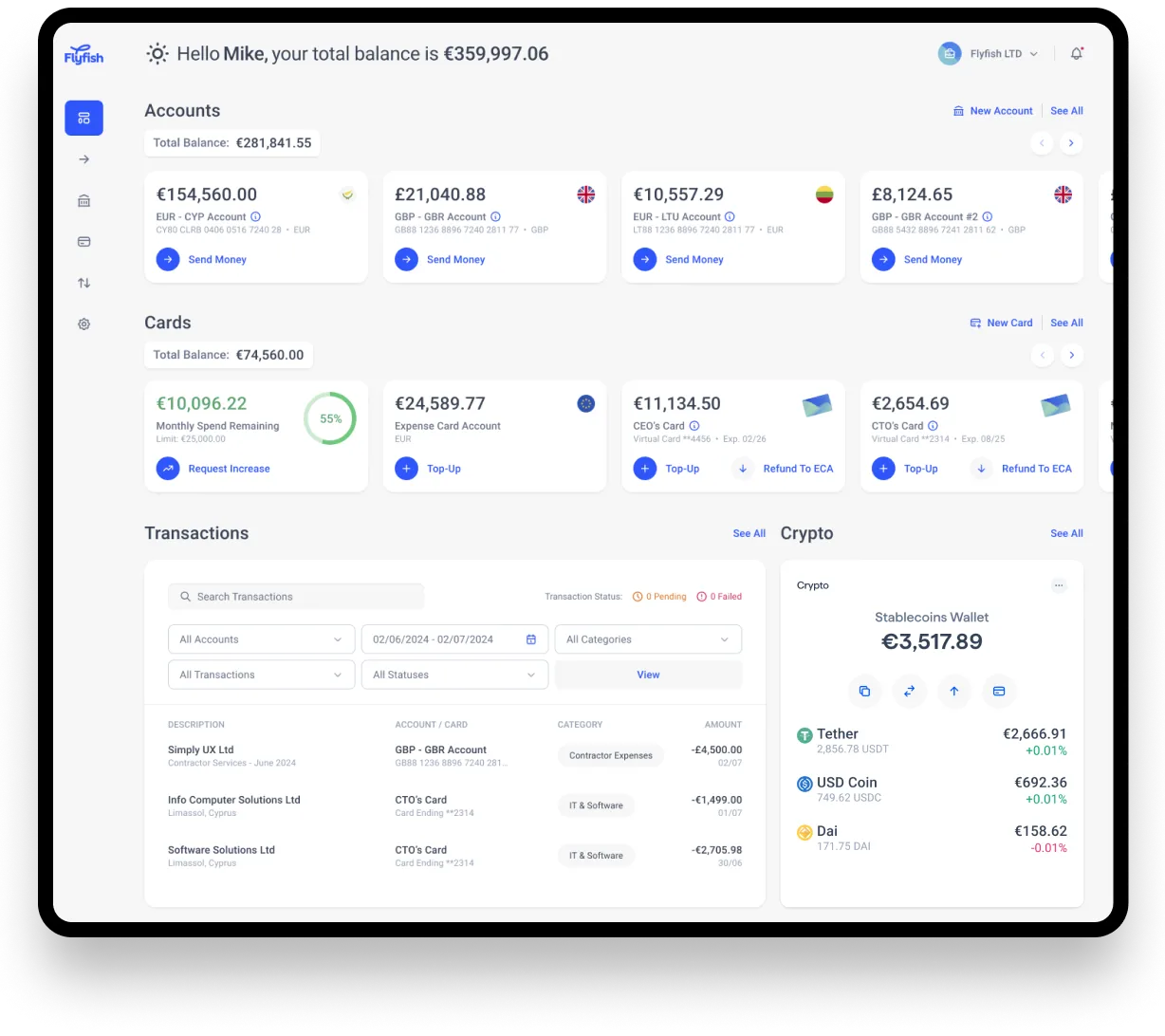
A debit card product needs more than an interface. Devopsly built the financial ledger, cloud infrastructure and delivery pipelines supporting Flyfish’s card issuance platform.
At a glance
01 / The brief
Flyfish was preparing to launch debit card issuance across EU and APAC markets under regulatory deadlines.
The engineering work covered the record of financial activity, the infrastructure running the services and the process for releasing changes. Those parts needed to be considered together.
Security requirements shaped the infrastructure. The delivery included encryption and web application security controls alongside networking, data services and application deployment.
02 / What we built
The scope ran from financial data design to the repeatable infrastructure and release process around it.
Financial records
Devopsly designed the financial ledger to retain transaction history, making the financial record an explicit part of the architecture.
Cloud foundation
Modular Terraform configuration described the AWS infrastructure, including multi-zone networking, EKS Fargate and Aurora RDS.
Application delivery
GitHub Actions pipelines supported blue-green deployments. KMS encryption and AWS WAF formed part of the platform’s security controls.
The engineering decision
Terraform expresses infrastructure as configuration that can be reviewed and reapplied. Delivery pipelines express the path from a code change to a release.
In this project, both sat alongside the ledger and application runtime. That connected scope is the point: the product and what it runs on were part of the same brief.
03 / The result
The delivered platform brought financial records, AWS infrastructure and application delivery together for the card issuance product.
After the platform work, deployments became more frequent and recovery times shorter.
A qualitative result, as reported by Devopsly.
A similar challenge?
A platform brief should cover what the product needs to do and how your team will release, observe and recover it.
Discuss your platformMore selected work
Confluence knowledge, connected to Zendesk.
Read the case studyWine collection software with offline capability.
Read the case studyPermission-aware answers to HR and pay questions.
Read the case study